A few years ago, one of my daughters broke her arm
November 04, 2026 · Originally published on The mobility climate
A few years ago, one of my daughters broke her arm. It was the second time; the first one had been a year or so earlier. It happened during a birthday party, in one of those infamous ball pits, a parque de bolas in Spanish. It was relatively late for us, and I didn’t particularly like the birthday girl or her mother, so I asked my wife to skip the stupid party and go back home, all of us together.
It wasn’t a clean break and setting her bone back in place was quite painful. During those days, I was angry with my wife for insisting on going to that party, but mostly angry with my wife. Feeling guilty thinking that maybe, just maybe, I could have done something different and avoided it.
A week ago, on 28 October 2026, in Toledo, a train driver received an order from Atocha’s CRC, one of ADIF’s rail traffic control centre. His train had stopped following a signalling issue, and he was told to resume his journey at normal speed, meaning high-speed. He acknowledged this order. However, realising this was wrong, he called back asking whether he was not supposed to drive at “marcha a la vista” (roughly 30-40 km/h). He was right, and ADIF’s CRC confirmed it[1].
A few minutes later, a second train, most probably moving over 100 km/h crashed into a third train, stopped on the Madrid-Sevilla high-speed line. As I write this, 69 people have died. Had the first followed the first order he was given and resume his journey at high speed, he would have reached the area of the accident roughly 20 minutes after the accident, potentially crashing as well into other two trains. By questioning the order, by knowing the rules and applying them, he was the first line of defence in avoiding a potentially higher death tool.
After the accident happened, I couldn’t stop wondering if he was suffering as I did when my daughter broke her arm, if he was thinking that maybe, just maybe, he could have done something different and avoided the train crash.
Even if none of my loved ones were affected, the accident has touched me deeply, as it has many people in Spain. Since it happened, I have been speaking with people in or very close to the railway sector, trying to understand what happened, what could have been done, what can be done.
Everyone I have spoken with has brought up the pain of the victims and their families. Everyone I have spoken with keeps returning to a particular story. You have read mine.
One pointed to the family of one of the train drivers involved in the accident, listening the voice of their son minutes before dying in the audio recordings leaked by the government. Another pointed to the people on the other side of that same call, who are not only potentially facing criminal charges but will have to carry the weight of what happened for the rest of their lives.
Each person involved in the accident has its own unique story. Each of them deserves our compassion and sorrow. Let’s keep all of them, together with their families and friends, in our thoughts.
To draw us near[2]
Most Spaniards agree that the priority is to avoid another tragic accident and to re-establish the high-speed rail system and our pride on it. Its importance goes beyond the high-speed network itself. In these times of political polarisation, the high-speed rail system is one of the few elements of agreement across the political spectrum.
Reestablishing the high-speed rail system and our pride on it can draw us near, can be a road to honour the victims and their families.
My account: a system under pressure
My account starts in 1992 with the inauguration of the first high-speed line in Spain: Madrid-Sevilla. In 2003, the line to Zaragoza started operations, reaching Barcelona in 2008. The business proposition was a stark contrast to the conventional railway service, a very competitive travel time combined with strong reliability. RENFE’s punctuality commitment was unbeatable: 50% refund for delays above 15 min.
In the early 2000s, the Spanish economy was booming. Everybody wanted the high-speed rail to reach their city. This was granted in 2005, with the political commitment at the highest level to bring the high-speed network to all the provinces. This promise survived a change of government and the financial crisis. The Infrastructure, Transport and Housing Plan (PITVI 2012-2024), written and approved during the worst moments of the financial crises, still included the map below, connecting all provinces by high-speed rail. If you feel that there are a few too many lines, you are not mistaken. It is not only that all 50 provinces are served, but there are also redundant lines, such as between Almería and Granada (south-east corner), with two high-speed lines connecting them.
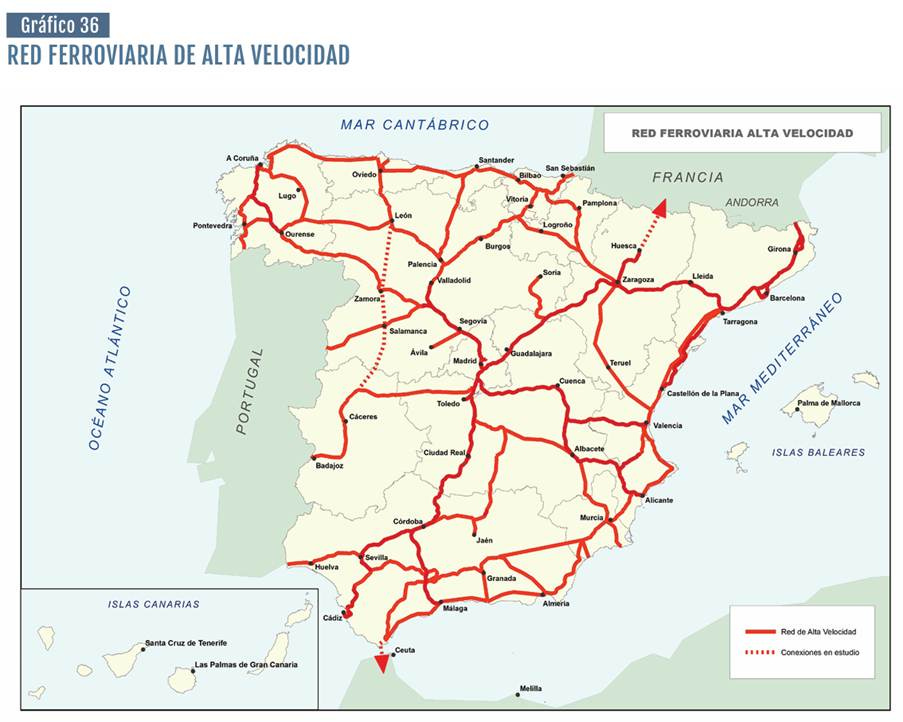
This political push for the expansion of the network is understandable. High-speed rail is great. And while there are debates about the actual benefits for smaller cities of being connected by rail, the truth is that all major economic centres are also major transport hubs. Tellingly, a “backwater” (a stretch of water connected to a river or channel, but outside its main current) is also way of describing isolated, neglected or left behind areas.
The issue is not that there is a political push for its expansion. The issue arises when this push (i) takes priority over the need to maintain and operate the network[3] properly and (ii) when it puts at risk the sustainability of the whole system, by adding sections without a clear business case.
According to the International Union of Railways, there are almost 700 km of high-speed lines under construction in Spain and an additional 800 km planned. This continued pressure to expand the network has interacted badly with the EU Funds, which are allocated regionally[4]. This has resulted in a geographical spread of the works and the extension of their construction periods. Just to give two examples: The Basque-Y started construction in 2006 (20 years ago) and Murcia-Almería in 2009. Neither is operational yet.
2007 marked the peak of Spanish prosperity. The crisis that started in 2008 was very deep and long. Unemployment reached more that 20%, public debt soured and budgets tightened. As a result, ADIF reduced its CAPEX and OPEX: less investments and less maintenance.
It also meant a halt to new hires. In principle, one might assume a hiring freeze would have little impact. However, maintained for several years, the hiring freeze has resulted in one of ADIF’s major challenges, as recognised by ADIF in its Strategic Plan 2030. At the time of its publication, the average age of ADIF’s workforce was 55 years. The challenge is not only the ageing workforce and its replacement, but how to ensure the transmission and handover of knowledge and experience to the next generation.
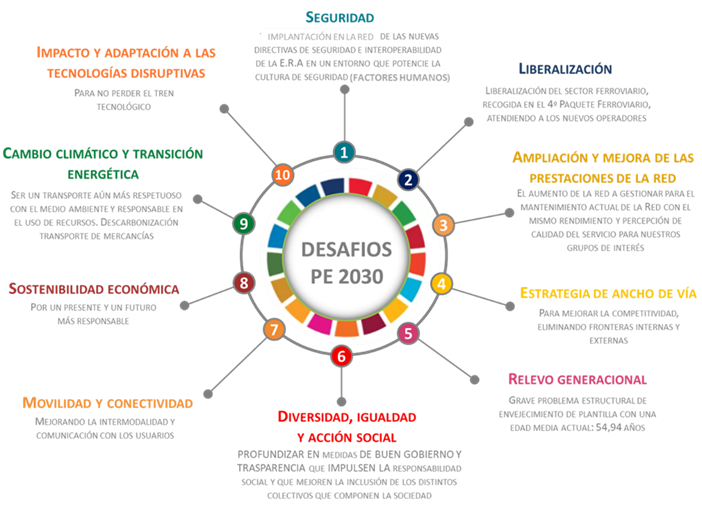
Since 2020, three new elements of pressure have been added: the rail liberalisation, climate change, and the Recovery and Resilience Plan. The rail liberalisation implied more trains, higher frequencies, cheaper tickets. However, there is no such a thing as a free lunch. More trains mean more resources are needed for the operation of the network. Higher frequencies mean less room for manoeuvre when something goes wrong. Cheaper tickets mean operating in a competitive, business-driven environment.
Climate change impacts have increasingly been felt in Spain, with changing weather patterns. And climate impacts the infrastructure, operations and maintenance of the railway network. The current climate is characterised by more frequent and more intense heavy rain episodes, combined with periods of drought; and higher extreme temperatures and longer heatwaves, combined with cold snaps. All of these place greater demands on the rail infrastructure and associated systems.
Finally, following Covid-19, the European Union put in place the Recovery and Resilience Fund (RRF). Spain was the second largest beneficiary, and ADIF one of the main bodies in charge of delivering it, with almost EUR 6 billion to be invested up to August 2026. Citing the numbers from memory (so, please don’t quote them), ADIF annual investments jumped from roughly EUR 800-1,000 million to EUR 1,500-2,000 million. In practice this meant combining several work streams at the same time (such as the investments in Madrid railway node, including Chamartín and Atocha, and the renewal of Madrid-Sevilla high-speed line).
All these factors have resulted in a loss of reliability of the system and the quality of service: (i) higher number of trains, and their associated higher dynamic loads on the infrastructure, (ii) a changing climate, (iii) the rush to implementation the RRF, (iv) the ageing workforce challenge, and (v) the push for continued expansion.
Nothing exemplifies this loss of reliability better than RENFE’s punctuality commitment, which was watered down in 2024. The goalposts were moved. The 50% refund was no longer for delays over 15min, but over 60min: four times more. As mentioned, this was not only a change in the refund policy, but a change to the whole business proposition. Moreover, it was also a clear demonstration of the degradation of the underlying system.
Beyond the high-speed rail system
In 2021, the Ministry of Transport published its Safe, Sustainable, and Connected Mobility Strategy. At its core, the aim of the strategy was a change of priorities: from the provision of transport infrastructure to the planning of mobility; from the long-distance transport to the daily mobility.
While the strategy was well intended, I believe that, today, we can say that it has been a failure[5]. It has not been able to constrain poorly justified expansions of the high-speed network[6]. At the same time, the priorities from the Ministry of Transport have moved away from its core. This is exemplified in the focus on urban mobility (managed by local and regional governments) with initiatives such as the cycling office, the single ticket (which, in =the words of a good friend from the ministry, is neither a ticket nor the single one), and the mobility law, which morphed from its initial aim of financing transport into enshrining a right to mobility on paper, without any clear application in practice.
Beyond transport
Unfortunately, the degradation of the underlying systems is not restricted to railways or the transport sector. As has written, first in his Substack post and then, just two days ago, in El País, Spain has suffered a string of similar failures.
In 2024, terrible floods in Valencia. In 2025, a nationwide blackout, originating in Spain but also affecting Portugal and the South of France. In 2026, (i) a fatal rail crash in January, (ii) a “violation of Spain’s territorial integrity”[7] in Ceuta, at end of July, and finally (iii) a second fatal rail crash, in October 2026.
The main law underpinning all these systems is the State Budget, the latest one approved being for the year 2023.
Postscript
This disclaimer appears in every post. And it should be clear from the text itself. But just in case, all views are my own, and do not represent my employer.
[1] More on this story, here: https://www.elconfidencial.com/espana/2026-10-29/accidente-ave-iryo-renfe-sevilla-marcha-normal-maquinaria_4455736/
[2] With thanks to Leonard Cohen for this verse.
[3] Just in passing, while there is a need to properly maintain the rail network in Spain, I would say that is not the main cause of this or the previous accident, as the high-speed rail Madrid-Sevilla had recently been renewed.
[4] I know, this applies only to the ERDF, but this is not the piece to get into a lengthy discussion about EU Funds.
[5] I write this having applauded the strategy when it was published
[6] For example, a new Estudio Informativo was approved for the high-speed line Sevilla-Huelva, with an indicative cost above EUR 1.6 billion. The cost of the detailed designs, already procured, amount to over EUR 30 million.
[7] Pedro Sánchez’s words: Pedro Sánchez denuncia “una violación de la integridad territorial de España” y culpa a las mafias que trafican con personas de la crisis en Ceuta - BBC News Mundo