TEN-T Nodes meeting in Bilbao
June 03, 2025 · Originally published on The mobility climate
*** The views presented here are entirely my own. They do not represent the positions of my employer, nor those of the stakeholders and clients in work with. For more info: A (not-to-long) disclaimer ***
The TEN-T regulation emphasizes the need for an enhanced collaboration across institutions in mobility planning and management, bringing together the Trans-European Transport Corridors and last-mile mobility solutions.
EIB Advisory, through the JASPERS initiative, is supporting the Spanish Ministry of Transport and Sustainable Mobility when operationalizing this vision.
As part of this effort, I had the opportunity to attend a workshop last week in Bilbao, bringing together key institutions responsible for mobility planning in the functional area defined by the TEN-T urban nodes of Bilbao, Donostia, and Vitoria.
Hosted by the Provincial Council of Bizkaia, the workshop included representatives from the Spanish Ministry of Transport, the Basque Government, the Provincial Councils of Araba, Bizkaia, and Gipuzkoa, the cities of Bilbao, Donostia, and Vitoria, and the Transport Authority of Gipuzkoa.
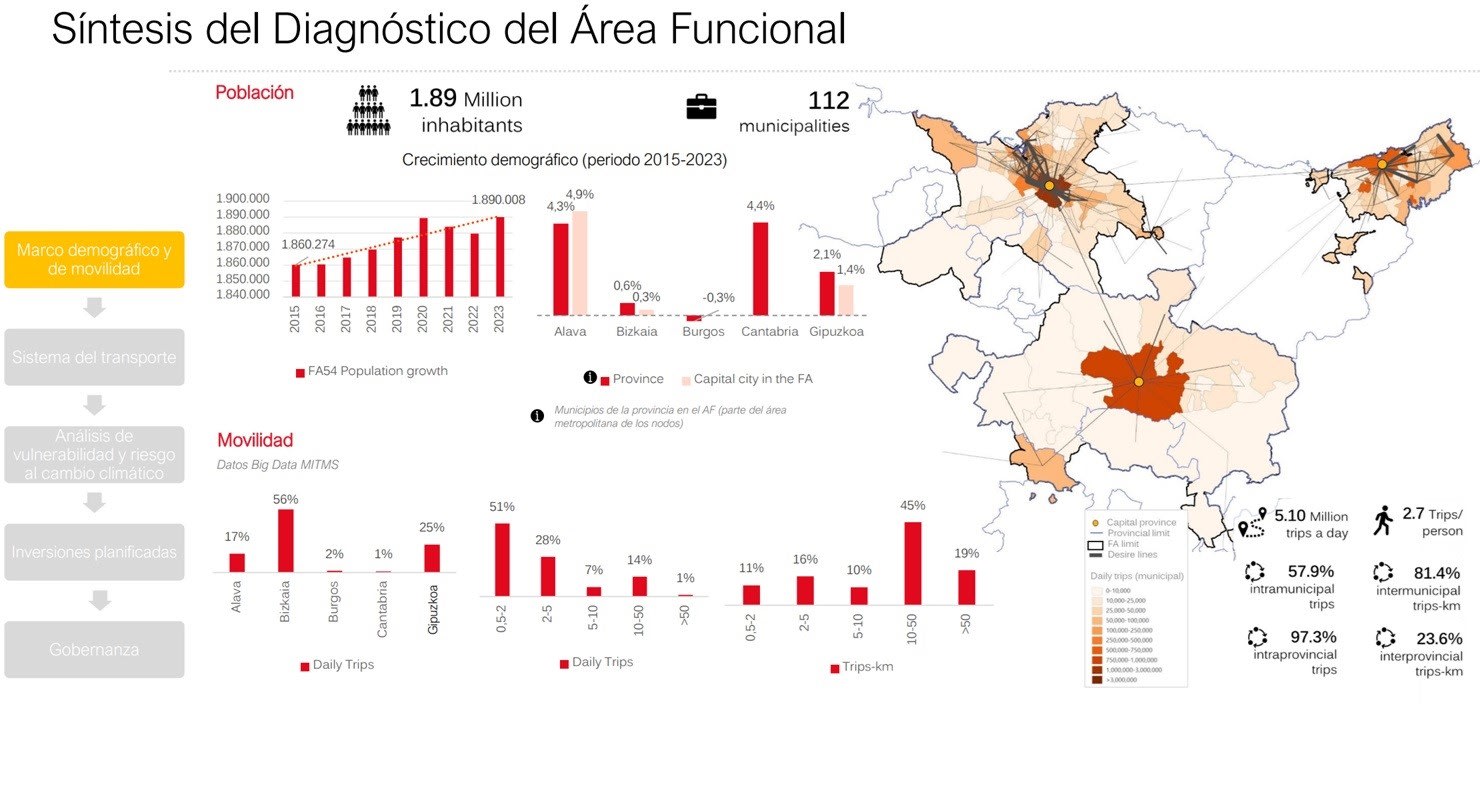
The mobility pattern in this area reflects a trend common to other major Spanish TEN-T urban nodes: while most trips occur within municipal boundaries, the majority of passenger-kilometres are generated by inter-urban trips. Mobility between the three capitals (Bilbao, Donostia, and Vitoria) is particularly significant.
In this context, the ‘Basque Y’ high-speed rail project promoted by ADIF should be highlighted. Currently under construction, the project will dramatically reduce the travel times between the three capitals. It will also play a key role, as part of the Atlantic Corridor, in connecting the Spanish and Portuguese rail networks with their French counterpart and to the rest of the European Union. The European Investment Bank is supporting the rollout and expansion of this strategic connectivity infrastructure for the Iberian Peninsula through various loans totalling €2.83 billion - Spain: EIB and Adif AV agree €430 million loan for the construction of the ¨Y vasca¨ high-speed rail line.
The following topics were presented in the workshop: the requirements that the TEN-T regulation poses on the urban nodes – including the reporting of mobility indicators; a first sketch of the National SUMP Support Programme for Spain; and a high-level diagnosis of the mobility in the functional area defined by the TEN-T nodes Bilbao, Donostia, and Vitoria.
More importantly, the workshop benefited from the participation of all the attendees, which helped to:
Identify key mobility investments planned by the different institutions.
Map the governance and financing structures of the public transport system.
Prioritize initiatives to foster inter-institutional collaboration in the functional area.
I returned to Brussels with three main takeaways:
A shared understanding of the need for collaboration, cooperation, and concertation between institutions. While responsibilities might be fragmented, citizen’s mobility needs are not.
The value of platforms that enable the dialogue, collaboration and joint problem-solving – such as this workshop.
The strategic priority of fare integration as a priority area be further explored between the different institutions.
Very thankful to all who made this workshop possible. EIB Advisory and the JASPERS mandate. The Ministry of Transport and Sustainable Mobility for the great cooperation we have established already since 2017. The Provincial Council of Bizkaia for hosting us. TYPSA for the technical assistance support they are providing in this initiative. All the attendees and institutions represented.
Thanks to all!