Andalucía: Probably the EU's largest single SUMP planner
May 11, 2026 · Originally published on The mobility climate
Even before the new TEN-T regulation was adopted, Andalucía was already ahead of its requirements for urban nodes, with the approval of the Metropolitan SUMP of Campo de Gibraltar.
Sustainable Urban Mobility Plans (SUMPs) are the cornerstone of the EU sustainable mobility push: improving accessibility, reducing congestion, promoting public transport and active mobility (cycling and walking), and decarbonising our cities. SUMPs feature prominently in the new TEN-T regulation, with SUMPs mandated for the TEN-T urban nodes (431 across Europe, broadly defined as the cities with populations over 100,000 inhabitants). Moreover, since 2021, SUMPs have been a pre-condition for EU funding: the Cohesion and European Regional Development Funds include SUMPs as a requirement (enabling condition) for funding sustainable urban mobility investments, while the EIB’s Transport Lending Policy includes SUMPs (or equivalent) as “a prerequisite for EIB support”.
Andalucía did not stop after approving the first one. In total, since 2023, Andalucía has approved eight Metropolitan SUMPs covering nine TEN-T urban nodes: Campo de Gibraltar (covering the TEN-T urban node of Algeciras), Málaga, Bahía de Cádiz (covering the TEN-T urban nodes of Jerez de la Frontera and Cádiz), Granada, Córdoba, Almería, Huelva, and Jaén. And there is one more under preparation, the Metropolitan SUMP of Sevilla.
As a result, the Regional Government of Andalucía is probably the single largest SUMP planner in the EU. EIB Advisory has been supporting Andalucía in these efforts since 2021.

Already delivering
Andalucía is already delivering on the promises of these eight metropolitan SUMPs. For example, the Granada Metro South Extension and the Málaga Metro Line 2 Extension are being built, while feasibility studies are advancing for new infrastructure such as the BRT of Campo de Gibraltar.
Three angles: functional area, governance and programming of investments
Of the many things I like about these metropolitan SUMPs, allow me to focus on how they have considered the functional area, its governance, and the programming of investments. All three elements are reflected in the TEN-T regulation.
Considering the functional area
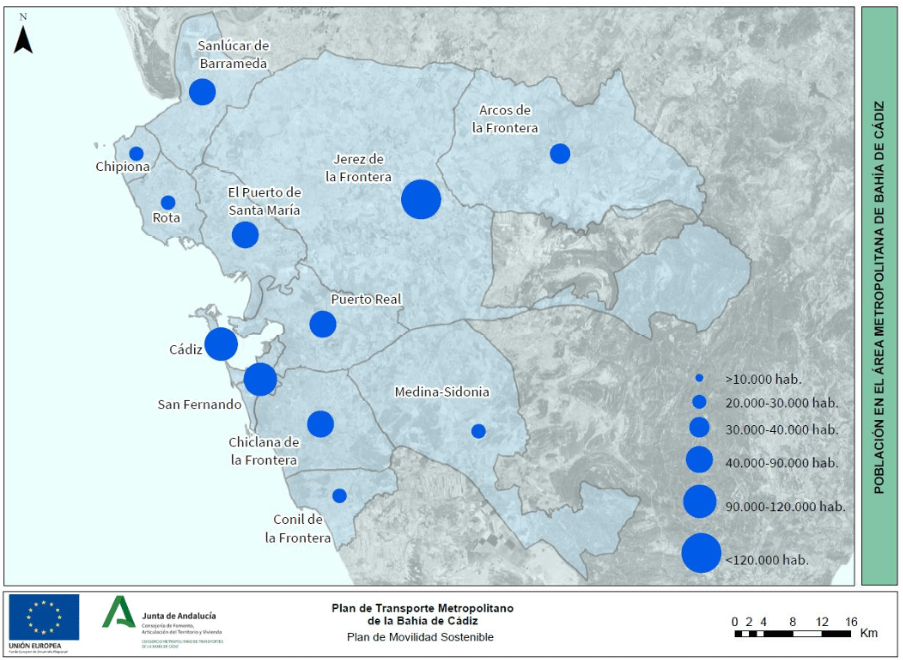
Metropolitan transport plans, by definition, go beyond the administrative borders of the main city. This is the case of the metropolitan SUMPs of Andalucía. Take, for example, the functional area covered by the Metropolitan SUMP of Bahía de Cádiz. It includes a total population of over 800,000 inhabitants across 12 municipalities. Jerez de la Frontera (population over 200,000 inhabitants) and Cádiz (population over 100,000 inhabitants) are both listed as TEN-T urban nodes. Together with them, there are another three cities with populations close to or just above 90,000 inhabitants: Chiclana de la Frontera, El Puerto de Santa María, and San Fernando.
The initial scope of the Metropolitan SUMPs was given by the definition of the metropolitan transport authorities (Consorcios de Transporte Metropolitano). This initial definition of the functional area has been assessed for each of the plans and expanded when justified, including new municipalities in the Consorcios.
Participation and Governance
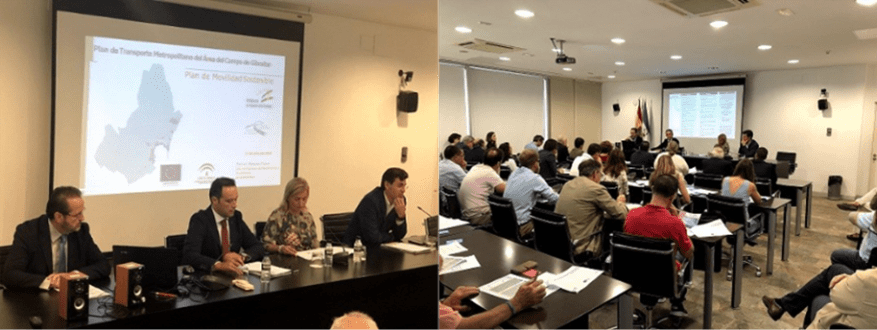
The metropolitan SUMPs are promoted, developed and adopted by the Regional Government of Andalucía. At first sight, it could look like a very isolated exercise. On the contrary, Andalucía has made great efforts to ensure adequate participation of civil society, not only through the Strategic Environmental Assessment, but also through specific participatory workshops and institutional dialogue which served as key inputs for the development of the Metropolitan SUMPs.
Moreover, before being adopted by the regional government, the Metropolitan SUMPs were discussed and approved by the relevant Consorcio de Transporte Metropolitano. These entities bring together the regional government and the local governments covered by each of the Metropolitan SUMPs. As a result, the Metropolitan SUMPs have been adopted with broad approval.
Programming of investments
Transport plans always need to face the tension between long-term transformative ambition and financial realism. Take public transport: we would like to electrify the entire bus fleet, to increase frequencies, to build trams and metros, to expand and upgrade the passenger hubs, to deploy a city-wide network of bike lanes.
At the same time, the available resources are (thank God) limited. We cannot do all of the above. We need to prioritise.
Andalucía has dealt with this tension smartly. The pipeline of investments resulting from each of the plans has been divided into two phases. Phase 1 includes those investments which are backed by the regional budget (projected to the years covered by each of the plans). Phase 2 includes the rest of the planned investments which are not supported by the current budget availability. The investments defined under Phase 2 might be implemented after the timeframe of the plans (normally up to 2030), or earlier if additional resources become available (notably the future EU budget).
EIB Financing and Advisory
Allow me to wear my EIB hat. The EIB is a long-standing financier of sustainable mobility in Andalucía, including Metro Line 1 in Sevilla, Metro Lines 1 and 2 in Málaga, the Metro in Granada, and the tramway in Alcalá de Guadaíra.
Moreover, as I mentioned before, EIB Advisory has been supporting the development of these plans since 2021. It has been a great challenge, and we have learnt a lot in the discussions with Andalucía and the consultants developing the Metropolitan SUMPs. And we have done a lot. Let me just mention a few of them.
We worked with Andalucía on how to better include gender considerations in the development of these plans. You can consult the EIB blog post with the key takeaways.
We also worked together to align the metropolitan SUMPs with the climate neutrality objectives through the preparatory process. This work was the precursor of the SUMP topic guide on decarbonisation which was published by the European Commission and which you can consult here.
Finally, we brought both topics together, working on the inclusion of social aspects in the transition to zero-emission mobility. See our Assessment of social impacts in the context of the transition to zero-emission mobility.
And of course, we discussed the functional areas, the proposed measures, the demand analysis, the indicators, the objectives and all the key elements for the success of any SUMP.
It is the people
Allow me a final note to thank the whole team in Andalucía responsible for this success and the great collaboration, starting with the senior leadership of the Consejería for setting the policy direction and making these plans a priority.
And a special note of appreciation to Manuel Márquez Pigner, the civil servant who has shepherded the plans to completion: managing the consultants, engaging with stakeholders, and going through the bureaucratic hurdles. Not once, but eight times.
What makes Manuel stand out is his openness to work with people, consider different views and find creative solutions. If you saw him in a meeting or working at his desk, you probably wouldn’t notice it, but it is the closest thing to a Greek hero you will ever see. Manuel walks in the footsteps of Heracles. Eight of the Twelve Labours done. Where is his limit?